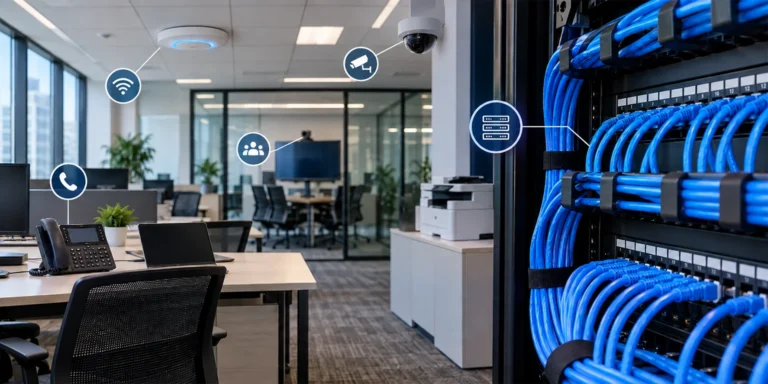
When a business phone call breaks up or disconnects unexpectedly, attention usually turns to the internet connection or phone service provider. Those are reasonable places to investigate, but they aren’t the only possible sources of trouble. Every wired VoIP phone depends on a physical connection to the office network, and problems with that connection can interrupt communication even when the phone system and internet service are functioning properly. VoIP cabling is therefore an important part of maintaining dependable business communications, particularly in offices where phones share network infrastructure with computers and other connected equipment.
The Connection Between Ethernet Cabling and Call Quality
VoIP calls travel across a network as packets of digital information. Although the phone system manages the conversation, the Ethernet connection provides the physical path between a wired phone and the network equipment serving it. When that connection operates correctly, voice data can move through the local network without disruption from the cabling itself. When the connection becomes unstable, the phone may experience transmission errors, lose network access, or disconnect entirely.
The distinction matters because not every cabling problem produces an obvious failure. A damaged patch cable might work intermittently, while a poorly terminated wall jack may cause problems only when the connected cable is disturbed. Depending on the fault, an Ethernet link may experience errors, negotiate a lower speed, or repeatedly disconnect and reconnect. A phone can appear to be working normally between these events, making the underlying issue difficult to identify without examining the connection.
These problems are especially disruptive during phone conversations because voice communication is time-sensitive. A brief interruption that might go unnoticed during ordinary web browsing can interfere with an active call. This does not mean every instance of distorted audio is caused by cabling, but it does explain why the physical network should be considered when call problems repeatedly affect particular phones or workstations.
How to Tell When Cabling May Be the Problem
The pattern of a communication problem often provides the first useful clue. If every phone in an office experiences poor audio at the same time, the cause may involve shared network equipment, internet connectivity, or the phone service itself. If one phone repeatedly disconnects while nearby phones continue working, however, the investigation can begin with the components serving that particular workstation.
Consider an employee whose phone loses connectivity several times a week. Replacing the handset might seem like a reasonable solution, but the problem could be a damaged Ethernet patch cord, a loose wall jack, or a faulty connection at the patch panel. Each of these components forms part of the physical path between the phone and the network switch. Until that path is examined, replacing the phone may do nothing to resolve the interruption.
This is where cable identification and testing become valuable. A basic wiremap test can reveal certain wiring faults, including open circuits, shorts, and incorrectly connected pairs. More comprehensive qualification or certification testing can evaluate whether installed cabling meets specified performance requirements. At ComRes, we provide cable toning, testing, and labeling services that help businesses identify existing connections and assess their physical infrastructure. Rather than assuming an entire network needs replacement, businesses can use the findings to determine which connections require attention.
Why Installation Quality Matters More Than Cable Category Alone
Businesses planning new VoIP cabling often begin by comparing Cat 5e and Cat 6 Ethernet cables. Although the distinction matters for network design, selecting a higher cable category does not automatically improve phone call quality. Most standard wired VoIP phones use relatively little bandwidth, and properly installed Cat 5e cabling can generally support their connectivity requirements without difficulty.
Installation quality has a direct bearing on that answer. Ethernet cables contain twisted pairs of conductors designed to maintain signal integrity. Excessive pulling, crushing, sharp bends, or poor termination practices can compromise their performance. Cable routes must also account for supported distance limitations and potential sources of electrical interference. For common twisted-pair copper Ethernet installations, the maximum channel length is generally 100 meters, including patch cords. Following these requirements helps ensure that the completed connection performs as intended, regardless of whether the business selects Cat 5e or Cat 6.
Reliable Business VoIP Starts With the Right Cabling Infrastructure
A reliable VoIP phone system needs a dependable physical connection to the network. When Ethernet cables are damaged, connections are poorly terminated, or network outlets are installed without sufficient planning, businesses may encounter problems that are difficult to distinguish from phone service or equipment failures. Understanding the role of the physical network makes it easier to investigate those problems and avoid unnecessary equipment replacements.
At ComRes, we help businesses establish VoIP cabling infrastructure suited to their communication needs. Our network cabling services include Cat 5e and Cat 6 installation, structured cabling, cable testing, labeling, and network cable management. Whether you’re preparing for a business phone upgrade, adding workstations, or investigating recurring connectivity issues, we can help you evaluate your existing infrastructure and plan the appropriate cabling solution. Request a quote today.